Last updated October 2026
Parents often ask when a baby can start swimming lessons, and whether there is any point when they are too young to swim on their own. The short answer is that infant lessons are not about swimming yet. They are about getting a baby comfortable in the water, with you beside them, so the skills that come later have something to build on.
★View the Best Swimming Schools in Dunedin→Here is what infant swimming lessons involve, when babies usually start, and what to sort out before your first class in Dunedin.
What infant swimming lessons are
A class you do together
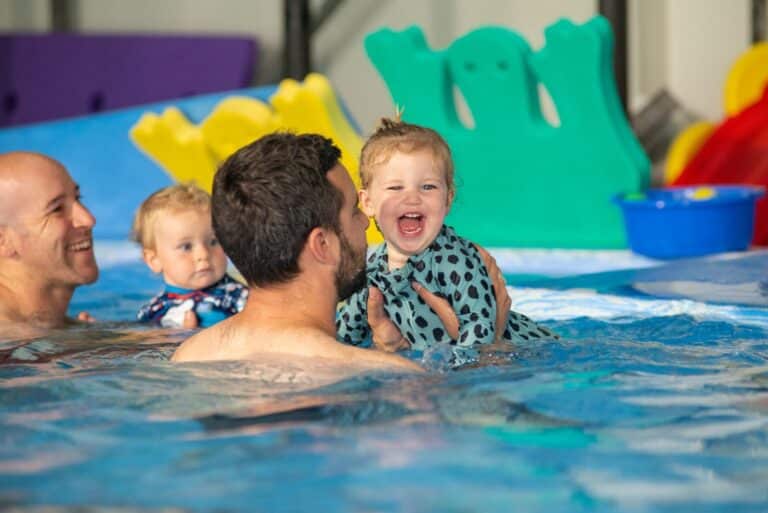
Infant lessons are usually called parent and child classes, and the parent is in the water for the whole lesson. A teacher leads a small group through songs, games and repetition, and you hold and guide your baby through each activity. Lessons are short, often around 30 minutes, because that is about as long as a baby stays happy and warm in the water.
What babies actually learn
At this age the goal is water familiarity and early safety habits rather than strokes. A typical programme works on:
- Being comfortable on their back and front with support
- Getting their face wet and brief, gentle submersion when they are ready
- Holding on to the pool edge or a teacher
- Safe ways to enter and leave the water
- Following simple routines and cues
What they do not teach
No baby class makes a child water safe. Babies and toddlers need constant, close supervision around any water, including baths, buckets and paddling pools. Water Safety New Zealand’s advice on keeping little ones safe is clear: never leave a young child unattended near water, and always stay where you can reach them.
When can babies start?
The usual age range
Most infant programmes in New Zealand take babies from somewhere between three and six months, and run until children are around three, when they move into preschool or beginner classes without a parent in the water. Check the starting age with the swim school you are considering, as it varies.
Is my baby ready?
Readiness matters more than an exact age. Good signs are steady head control, being comfortable in the bath, and being well in themselves. If your baby is unwell, has a cold or a runny nose, or has an upset tummy, skip the lesson and go back when they are better.
Can a one-year-old start?
Yes. Many children start at one or older, and toddlers often settle quickly because they can join in more of the songs and games. There is no penalty for starting later.
What to bring
- Swim nappy
- Pools require protective swim pants for children who are not toilet trained
- Hooded towel
- Babies lose heat quickly once they are out of the water
- Warm layers and a hat
- For the walk back to the car, especially in a Dunedin winter
- A feed or snack
- Babies are often hungry after a lesson
- Your own togs
- You are in the water too
Making the first lessons go well
Timing
Book a class time that fits around naps and feeds. A tired or hungry baby rarely enjoys the water, and a slot that suits your routine makes it easier to keep going week after week.
Tears are normal
Plenty of babies cry in their first few lessons. The pool is noisy, bright and full of new faces. Stay calm, keep your baby close and let the teacher guide you. Many settle within a few weeks, and teachers who work with infants see it every term.
Consistency beats intensity
Babies learn through repetition, so a short class every week through a term does more than the occasional long swim. Many swim schools also run holiday blocks if you want to keep things going between terms.
Choosing infant lessons in Dunedin
Dunedin’s weather means indoor, heated pools are the practical choice for year-round lessons, and infant classes run in term time across the city and in Mosgiel. When comparing options, ask:
- What age does the class start, and when do children move up?
- How many babies are in each class?
- How warm is the pool, and is there a warm space to change?
- Are classes on weekdays, Saturdays or both?
- Is there a make-up lesson if your baby is sick?
Where JC Swim School fits
JC Swim School is a Dunedin swim school founded by swim educator Jill Clarke, with more than 30 years of teaching families. Its parent and child classes are for babies and toddlers from six months to three years, with 30-minute lessons built around songs, repetition, play and early water safety skills.
Parent and child classes run at the Dunedin North Intermediate pool in Opoho and Te Puna o Whakaehu in Mosgiel, including Saturday mornings. When your child is ready to swim without you, they can move into beginner classes. You can register online for term lessons or holiday blocks.